Kids these days can successfully navigate a variety of apps on a digital tablet before they learn to tie their shoes, yet ophthalmologists still ask them to sit and stare at a blinking light for 5 to 10 minutes to complete a visual field test. Technology such as virtual reality (VR) is especially engaging for children, who often perceive these devices as akin to games. VR creates a simulated, immersive environment that allows a user to interact with a computer-generated world in real time through goggles or a headset.
In ophthalmology, VR has been used successfully to enhance surgical training, determine ocular misalignment in patients with strabismus, provide therapy for children with amblyopia, and perform visual field testing.1 VR perimetry (VRP) is gaining interest given its portability and high rate of patient acceptance.2,3
ADVANTAGES AND DISADVANTAGES OF VRP
Standard automated perimetry (SAP), performed with the Humphrey Field Analyzer (HFA; Carl Zeiss Meditec) or Octopus Perimeter (Haag-Streit), is considered the gold standard for diagnosing and monitoring visual field loss. SAP, however, can be challenging for children, who often have a short attention span and difficulty understanding and following instructions. Maintaining central fixation on a static target and stabilizing their head position in equipment designed for adults add another layer of difficulty for pediatric patients.4 Additionally, diagnostic testing in children often relies on their cooperation and engagement, which may be limited in unfamiliar or stressful clinical settings.
VRP introduces a familiar, game-like environment for children, potentially making testing not only feasible but also enjoyable. Thanks to the portable nature of VR devices, testing can be conducted in nearly any setting. Of course, no technology is without its challenges. VR headsets can cause discomfort, and the weight of the device and its external battery pack can put strain on the child’s head and neck.1 Cybersickness, a form of motion sickness that occurs while using digital devices, has also been noted with VR use.1,5 Last, many VR devices are designed for older children and adults and may not fit younger children’s heads comfortably.3
COMPARING VRP TO SAP
Although children with glaucoma appear to prefer VRP to SAP,6 significantly more data exist on the use of VRP in adults. We recently published a systematic review comparing VRP to SAP in adults with glaucoma that identified 14 studies that described 10 VRP devices, including the Advance Vision Analyzer (Elisar), VisuALL (Olleyes), Vivid Vision Perimeter (Vivid Vision), Oculus Quest (Oculus), Smartphone-based Campimetry (Carl Zeiss Meditec and SmartCampiTracker), Toronto Portable Perimeter (VEM Medical Technologies), VirtualEye (Arrington Research), C3 Fields Visual Field Analyzer (Alfaleus and Remidio), Radius (Radius), and Virtual Field (Virtual Field).3
Each of these VR systems has its own unique specifications. Some include eye tracking technology, whereas others do not. The VisuALL device uses white-on-white threshold perimetry with Goldmann size III stimuli, features a background luminance ranging from 1 to 10 cd/m2, and incorporates eye tracking technology to assess test reliability through fixation monitoring. In contrast, the Vivid Vision Perimeter uses black-on-white suprathreshold perimetry with a Goldmann size III stimulus and a fixed background luminance of 25 cd/m2, but the device does not incorporate eye tracking and thus has no built-in reliability metrics.
Despite the growing body of literature evaluating VRP in glaucoma, research on its use in children is limited, with only five studies across two devices published to date.
VisuALL
Wang et al evaluated the VisuALL device in 39 patients with glaucoma aged 7 to 21 years. The researchers reported 87.5% agreement between VRP and HFA in detecting the presence or absence of any visual field defect and 72.2% agreement in detecting the presence or absence of fixation-threatening field loss.7 Groth et al evaluated the VisuALL in 50 healthy children aged 8 to 17 years and demonstrated successful mapping of threshold sensitivity and high patient satisfaction scores compared to the HFA.8 Pruett et al also evaluated this device in 19 healthy children aged 8 to 17 years and found modest test-retest repeatability, with an intraclass correlation coefficient for mean deviation of 0.70 compared to HFA results.9 Most recently, Alvarez-Falcon et al evaluated the use of the VisuALL device in 97 healthy children aged 6 to 17 years and found the test to be well tolerated.10
Vivid Vision Perimeter
The other VRP device that has been studied in children is the Vivid Vision Perimeter. In a cohort of 23 patients aged 7 to 18 years, investigators found a modest correlation with HFA, with an intraclass correlation coefficient of 0.48 for mean sensitivity. Notably, all children preferred VRP over SAP.6
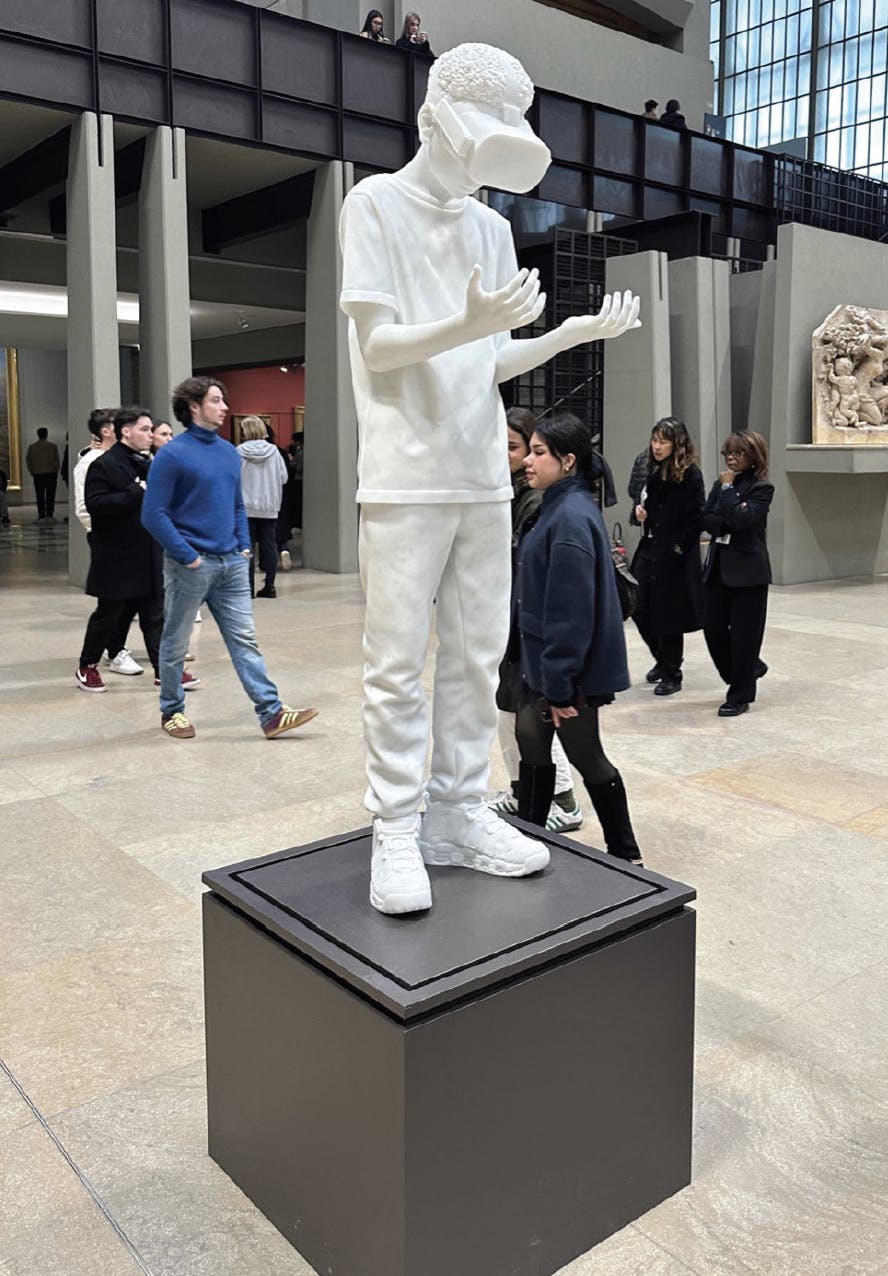
Figure. The sculpture This Is How We Play Together from the exhibition L’Addition by the artist duo Michael Elmgreen and Ingar Dragset on display at the Musée d’Orsay in January 2025.
(Courtesy of Julius Oatts, MD, MHS)
These early studies indicate promising results for VRP in children, but more robust validation studies with larger sample sizes, diverse patient groups, and varying types and severities of glaucoma are required to confirm VRP’s reliability, accuracy, and clinical utility compared to traditional SAP.
FUTURE DIRECTIONS
The VisuALL dominates the pediatric perimetry literature likely thanks to its ability to gamify testing. The device has a module specifically designed to be child-friendly by allowing the test taker to maneuver a rocket ship among planets and asteroids as a way of assessing peripheral vision. This novel approach to perimetry has been well accepted by children, but data directly comparing this form of VRP to traditional perimetry are still emerging.
Overall, the future seems bright for VRP. As this technology advances, it has the potential to make visual field testing more accessible to and engaging for children by providing a familiar and fun game-like experience. VR offers a unique opportunity to transform how ophthalmologists care for children with glaucoma and other vision-threatening conditions. Who knew that a popular gaming device could help bridge the gap between diagnostic need and pediatric cooperation? We just can’t promise that it will help children learn to tie their shoes.
1. Iskander M, Ogunsola T, Ramachandran R, McGowan R, Al-Aswad LA. Virtual reality and augmented reality in ophthalmology: a contemporary prospective. Asia Pac J Ophthalmol (Phila). 2021;10(3):244-252.
2. Hu GY, Prasad J, Chen DK, Alcantara-Castillo JC, Patel VN, Al-Aswad LA. Home monitoring of glaucoma using a home tonometer and a novel virtual reality visual field device: acceptability and feasibility. Ophthalmol Glaucoma. 2023;6(2):121-128.
3. Hekmatjah N, Chibututu C, Han Y, Keenan JD, Oatts JT. Virtual reality perimetry compared to standard automated perimetry in adults with glaucoma: a systematic review. PLoS One. 2025;20(1):e0318074.
4. Kumar A, Hekmatjah N, Yu Y, Han Y, Ying GS, Oatts JT. Factors associated with visual field testing reliability in children with glaucoma or suspected glaucoma. Am J Ophthalmol. 2024;264:187-193.
5. Weech S, Kenny S, Barnett-Cowan M. Presence and cybersickness in virtual reality are negatively related: a review. Front Psychol. 2019;10:158.
6. Mesfin Y, Kong A, Backus BT, Deiner M, Ou Y, Oatts JT. Pilot study comparing a new virtual reality-based visual field test to standard perimetry in children. J AAPOS. 2024;28(3):103933.
7. Wang B, Alvarez-Falcón S, El-Dairi M, Freedman SF. Performance of virtual reality game-based automated perimetry in patients with childhood glaucoma. J AAPOS. 2023;27(6):325.e1-325.e6.
8. Groth SL, Linton EF, Brown EN, Makadia F, Donahue SP. Evaluation of virtual reality perimetry and standard automated perimetry in normal children. Transl Vis Sci Technol. 2023;12(1):6.
9. Pruett JK, Linton EF, Donahue SP, Groth SL. Accuracy and reproducibility of virtual reality perimetry in children. J Pediatr Ophthalmol Strabismus. 2024;61(4):262-266.
10. Alvarez-Falcón S, Wang B, Taleb E, et al. Performance of VisuALL virtual reality visual field testing in healthy children. J AAPOS. 2024;28(1):103802.